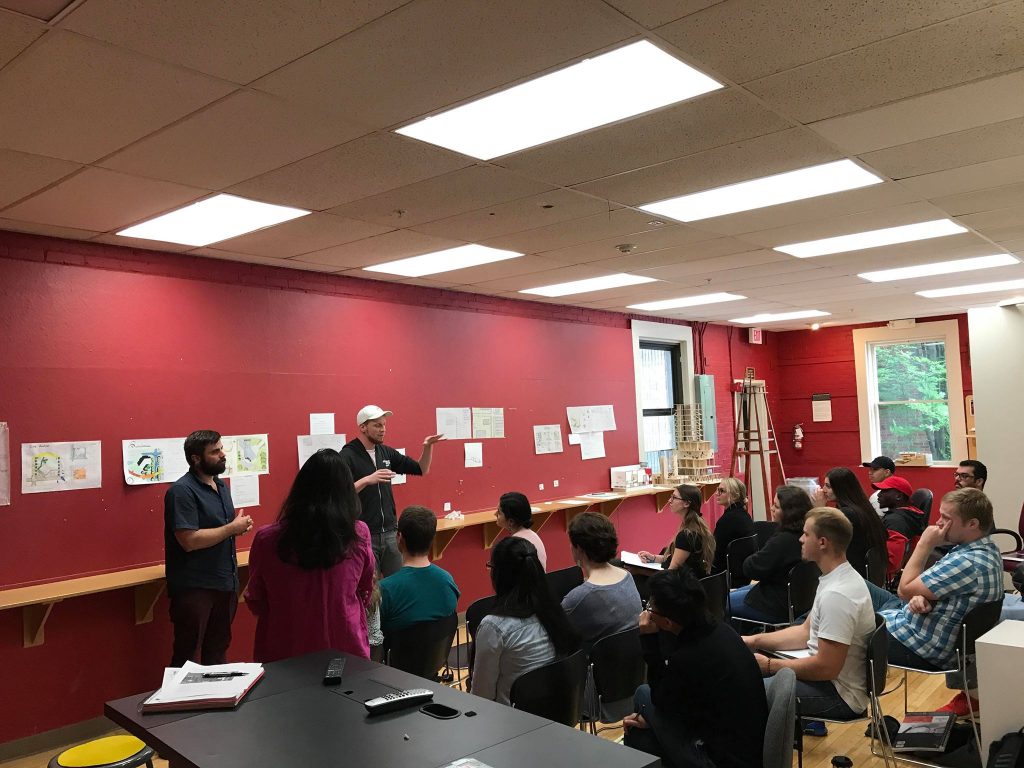
Typically when students think of a high-credit course, four or six is the number that springs to mind. Yet, this summer that number is even higher.
The University of Idaho Architecture BootCamp is a rigorous, 10-credit summer course, designed to give students advanced standing in UI’s architecture program.
Students began the course June 11, and have since been participating four days a week from 8 a.m. to 5 p.m. This will continue until Aug. 3, when the course ends.
“The goals for the program are really trying to give students a strong sense of basic design techniques and basic design specific to architecture and interior design,” said Randall Teal, program head of architecture and associate professor of architecture at UI. “So when you get down to it, we’re really focusing on architecture fundamentals.”


Randall Teal
Teal said the goal is to put students on strong enough footing so they can grow into the same level of expertise that third-year students have.
“In a sense we’re trying to catch people coming from these different backgrounds in a sort of common net, and provide them with a certain skill set so that they can move forward and they don’t have to start from scratch,” Teal said. “Ultimately it’s a living portfolio, we want to see where they’re at and put them in the right position.”
The program is open to internal transfers, community college transfers and anyone with a finished degree. Additionally, even those who might not meet these criteria are welcome.
“It’s sort of the same concern as teaching any introductory course, in the sense that you do certain introductory things, and some people might find that more remedial and some might find it more advanced,” Teal said. “But hopefully once you sort of get past the initial introductory part it all blends together.”
Teal said the dynamic begins to change when a level of interactivity and physicality is injected into the program.
“It resonates with a lot of people, and we try the best we can, but the ambiguities of that can freak some people out,” he said. “There’s a workshop quality to it, and that helps. If we sat around having eight-hour lectures that would be problematic, but they’re having field trips, doing hands on exercises and so on. There a good mixture, and in a way it’s sort of indicative of the profession.”
The program has been around for a few years now, and while it has progressively grown larger, it is still considered new. Teal said initially there were only three or four students, but this year there are 20.
“Unlike stereotypical summer school, the students here are generally highly energetic, upbeat and excited, so that actually really helps the entire class,” Teal said. “They do end up kind of helping each other, bonding together as a group to achieve their common goal.”
While some projects are done individually, the students oftentimes have to work in a group or partner environment.
Mathew Vollendorf, a UI graduate student, and Tyler Schram, a nontraditional transfer from Boise, are just two examples of students utilizing the bootcamp to catch up.
The two students were partnered up for a site analysis for their materials and methods class, given a general location on campus behind the Hartung Building and instructed to place an art gallery there. Research included the many environmental factors, existing structures and vegetation that was present, although the project was not to scale.
The duo said they worked very well together, and if given the chance, would be glad to team up together again.
“I do like the eight hours a day, because it forces you to learn,” Vollendorf said. “To be quite frank, we’re paying for this out of pocket because you don’t qualify for financial aid over the summer. I want to take advantage of it as much as possible, and this forces you into the academic mindset when everyone else is having fun.”
Schram said that while the program is rigorous, he sees the immense value in it, and learned more in the first few weeks than he did in his last semester of classes.
“That’s kind of the principle with this program though, not just bootcamp but architecture in general,” Schram said. “You end up doing a lot of it outside, and I think we wrote our summers off when we signed up for it, but it’s worth it and it helps us get caught up.”
The students go through two years in this short time frame. The first year consists of arts studio and some introductory architecture courses, while the second year focuses on foundational architecture studios, and architecture and interior design.
“There’s not answers in the same way there are in a math class, so sometimes you’ll get new students saying ‘Well what do you want me to do? Is this right?’” Teal said. “You have to tell me. You have to tell me what you’re trying to do, and then we’ll talk about how to do it stronger as you go forward. It can be an uncomfortable space for some students, but getting used to this is almost as important as the actual skillset and principles being taught.”
Max Rothenberg can be reached at arg-arts.uidaho.edu